
Economiain EnglishRussia
Russia, a Bitter Start to 2026: Oil Revenues Plunge 50%. Global Prices Will Decide the Budget’s Future
Russia 2026, Oil Revenues Plunge: -50% in January. Moscow’s Budget Trembles Under Low Prices and Strong Ruble as War Chest Thins.

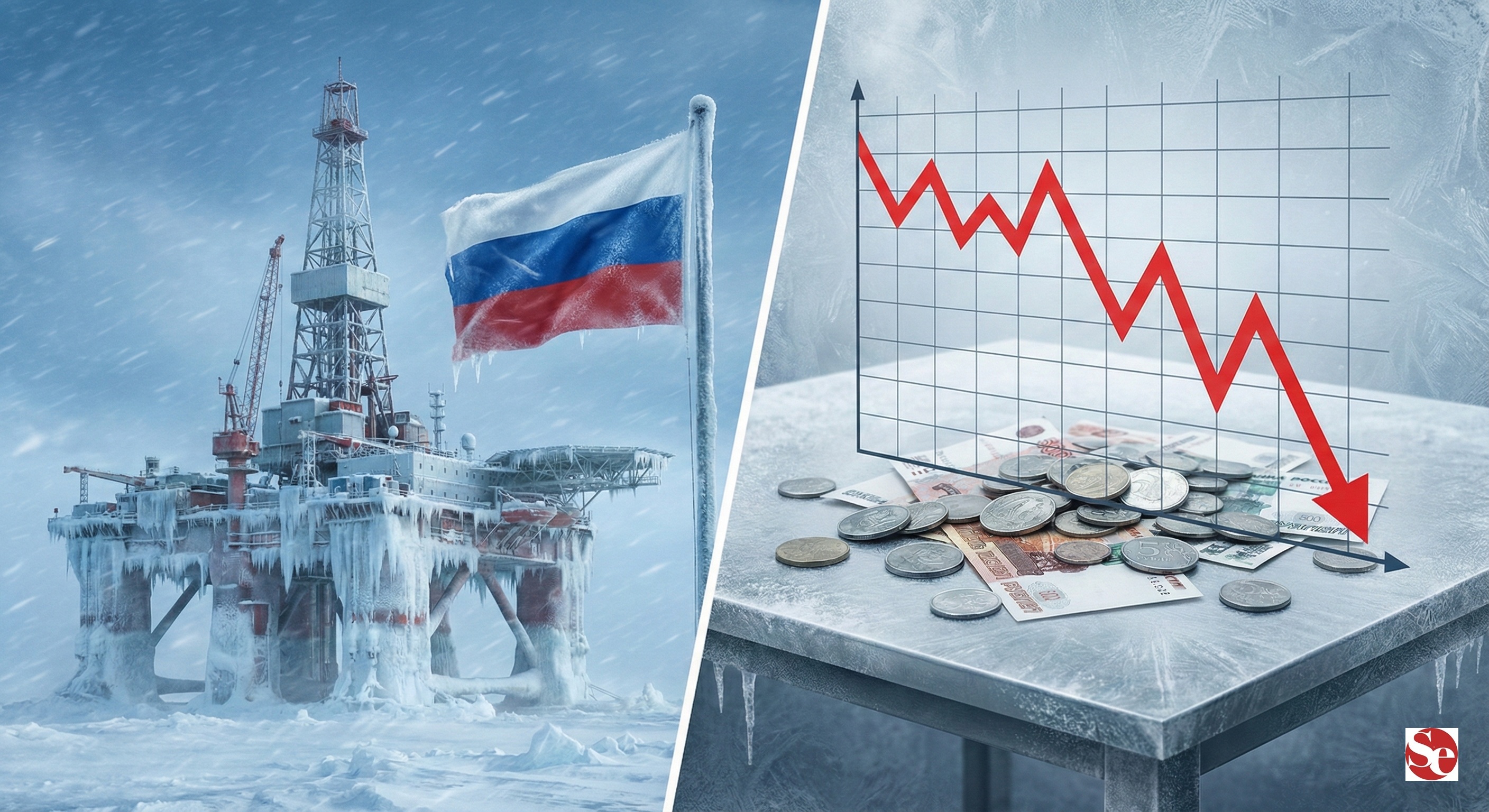
Russia is heading into 2026 facing a familiar problem, though this time with decidedly sharper edges: oil revenues, the vital lifeblood financing the state budget and the war effort, are shrinking before our eyes.
According to the latest calculations based on Reuters data, tax proceeds from crude oil production for January could fall to approximately 380 billion rubles (about $4.7 billion). This would mark the lowest monthly take since late 2022.
For a government that still leans heavily on petrodollars (or rather, petro-rubles) to sustain military spending and social obligations, the timing could not be worse. The numbers, stark and unadorned, paint a worrying picture for the Kremlin:
- -16% compared to December;
- -50% (a true collapse) compared to January of last year.
The Culprit? Price, Not Just Sanctions
Oil prices did the most damage. Russian export blends traded at significantly lower values in December compared to November, with an average drop of 12%. This mechanically reduced the Mineral Extraction Tax (MET), which is inextricably tied to these quotations.
According to the agency Argus, Russia’s main export grade, Urals, was selling below $35 per barrel on Friday, December 19th. A level that is likely causing tremors in Moscow’s accounting departments.
Paradoxically, the strengthening of the ruble exacerbated the situation. A stronger local currency reduces the value of export earnings once converted, further hitting the state coffers. Refining margins also weakened, dragging down tax receipts from oil products alongside crude.
Here is a summary of the fiscal situation for crude produced in December (payable at the end of January):
| Indicator | Estimated Value | Monthly Change | Annual Change |
| Total Tax Revenue | ~380 bn Rubles | -16% | -50% |
| Effective Rate (per tonne) | ~14,266 Rubles | -20% | > -50% |
These taxation levels take us back to territory last visited in December 2022, when the European Union’s embargo on Russian oil formally kicked in.
Not an Isolated Case
This slide is not a solitary statistical data point. Calculations show that Russia’s combined oil and gas revenues nearly halved year-on-year in December, falling to levels last seen during the demand crash of the pandemic era in 2020.
Multiple factors are squeezing cash flow:
- Lower international prices;
- A stronger currency;
- Widening discounts on Urals crude (exacerbated by U.S. sanctions on giants like Rosneft and Lukoil).
The strain is beginning to show in policy debates. Moscow has already floated the idea of tax relief for Gazprom to cushion the collapse in pipeline gas exports to Europe. The theory is that there may be some offset via higher taxes elsewhere in the energy sector. However, this kind of “fiscal reshuffling” is very telling of the underlying problem: oil and gas still supply roughly a quarter of Russia’s budget, but the safety cushion is thinning.
Outlook: The Market is the Referee
For now, Russia can likely absorb the blow. Its reserves and war economy have shown unexpected resilience. However, if oil prices remain soft and sanctions continue to bite, early 2026 is shaping up to be less forgiving than the Kremlin would like.
It is necessary to clarify a fundamental point, often ignored by superficial analysis: Russia will certainly be able to search for (and find) alternative routes to export its oil and gas, utilizing ghost fleets or triangulations with friendly nations. However, Moscow’s capacity to finance its budget will depend, more than on the volumes exported, on the international price of oil. If the barrel remains low, selling more will achieve little. It is the hard law of supply and demand, and not even Moscow can repeal it by decree.
Q&A
Why does a stronger ruble hurt Russian state revenues?
It may seem counterintuitive, but for an economy based on commodity exports like Russia’s, a currency that is too strong is a liability. Oil is sold in dollars (or yuan), but taxes and state expenses (salaries, pensions, internal military costs) are paid in rubles. If the ruble strengthens against the dollar, every dollar collected from oil sales is worth fewer rubles once converted. Consequently, the State collects less local currency to spend on the domestic budget, creating a hole in public accounts.
Does Russia risk default or economic collapse in 2026?
Not immediately. Despite the drastic drop in revenues (-50% year-on-year), Russia still possesses reserves and the capacity to maneuver fiscal levers, as demonstrated by the discussions on aid to Gazprom. However, the “cushion” is wearing thin. If oil prices remain below $40-50 for the long term, the government would be forced into unpopular choices: cutting social spending, raising internal taxes, or printing money (generating inflation) to fund the war and the state machine.
Can alternative export routes save the budget?
Only partially. Russia has already redirected much of its export towards Asia and other “non-aligned” markets to bypass Western sanctions. The current problem, however, is not so much the quantity of oil sold, but the price at which it is sold. If the global market is depressed and Urals is trading below $35, even exporting at full capacity yields minimal profit margins. Alternative routes guarantee the volumes, but the global market dictates the value of those volumes.
 Rimani aggiornato seguendoci su Google News!

Per i carri armati flessibilità, per famiglie e imprese austerità: la doppia morale di Bruxelles

L’India accende il suo reattore autofertilizzante: un passo verso l’indipendenza energetica nucleare

Quando l’EBITDA racconta una storia migliore della realtà

Oltre le utopie dell’IA: arrivano i robot di servizio domestico che possono cambiare il mercato del lavoro

You must be logged in to post a comment Login